Ekadashi 2027 list: all 25 dates with parana times
Ekadashi 2027 list: all 25 fast dates with tithi and parana times for New Delhi, month by month, and the 3 Ekadashis where families and Vaishnavas differ.
Free tithi birthday finder
One is on the calendar. One is on the moon. Tell us when and where you were born, and we will find your moon birthday for the next 100 years.
In the Hindu calendar, your birthday is not a date. It is a moon day, called a tithi. Your tithi comes back every year, but on a new date. This site finds those dates for you.
The moon sits next to the sun, so we can not see it. Then it starts to move away.
Think of the gap between the sun and the moon. Each time the gap grows by 12°, a new tithi starts. One tithi lasts about a day, from 20 to 27 hours.
The first 15 tithis are Shukla Paksha, the bright half. The moon gets bigger each night, up to the full moon, called Purnima.
The next 15 tithis are Krishna Paksha, the dark half. The moon gets smaller each night, down to the new moon, called Amavasya.
12° × 30 = 360°, one full circle. It takes about 29.5 days. Then it all starts again.
A calendar year has 365 days. Twelve moon months have only 354. So your tithi comes about 11 days sooner each year.
Every 2 or 3 years, the calendar adds one extra moon month. Then your date jumps back. This is why Diwali and Holi move around too.
One tithi, year by year, in New Delhi
A calendar day starts at midnight. A panchang day starts at sunrise. The tithi running at sunrise gives the day its name. And sunrise comes at a different time in each city.
18 November 2026. A new tithi starts at 06:05, India time.
Sun up at 05:51
That day is Shukla Ashtami
Sun up at 06:47
That day is Shukla Navami
Same day. Two cities. Two tithis.
This tells us the moon month you were born in.
A tithi can change at any hour. On 1 January 2000, a baby born in India at 10 am and a baby born at noon have different tithis.
Sunrise comes at a different time in each city, so your dates can change too.
Your tithi, your moon month, and your moon birthday for the next 100 years.
It takes less than a minute. It is free, and you do not need to sign up.
Your details stay on your device.
92,839
tithi start times worked out from NASA JPL data, the same kind of data used to fly spacecraft. They cover the years 1900 to 2149.
99.99%
of 91,311 days at New Delhi matched a second, separate astronomy system. The other 8 days were all within 18 seconds of a tithi change.
3,095
moon month names checked the same way, with no differences.
Private by design. It runs on your own phone or computer. We never see your birth details.
No secrets. See the real code and every test.
How it worksEkadashi 2027 list: all 25 fast dates with tithi and parana times for New Delhi, month by month, and the 3 Ekadashis where families and Vaishnavas differ.
Hindu calendar 2027: all 51 festivals month by month with date, day and tithi, and the ones like Maha Shivratri that fall a day before plain calendars show.
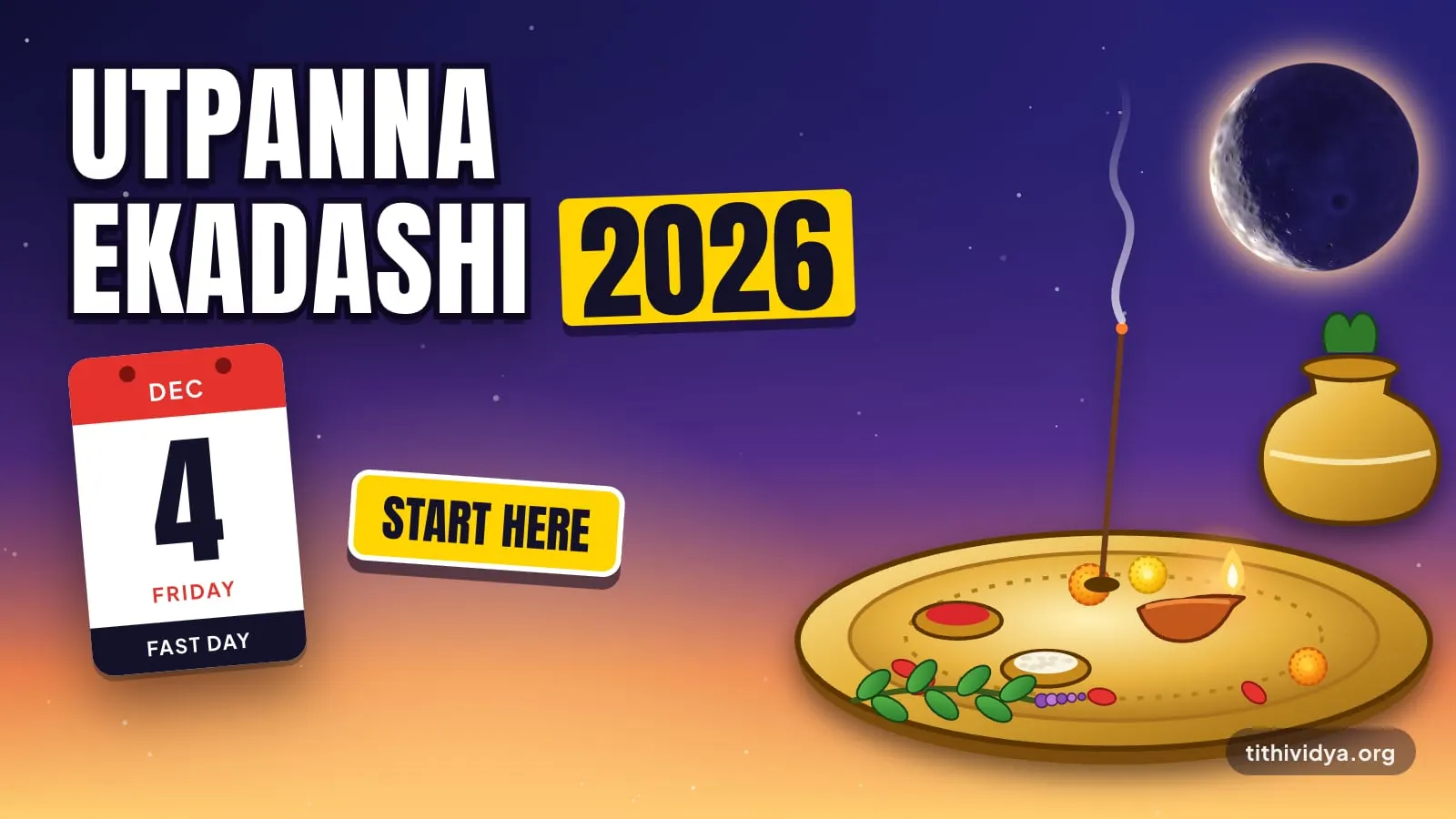
Utpanna Ekadashi 2026: tithi times, the parana window for 12 cities, the story, and why it's the traditional Ekadashi to start your fasts with.
A tithi is a moon day. It is one step of the moon's trip around us. Each time the moon moves 12 degrees further from the sun, a new tithi starts. There are 30 tithis in one moon month.
It is the day your tithi comes back each year, in the same moon month you were born in. Many Hindu families mark this day. It is also called your janma tithi.
Enter your birth date, time and place on our Find my tithi page. We show your tithi, your moon month, and your tithi birthday for the next 100 years.
Twelve moon months are about 11 days shorter than a calendar year. So your tithi comes about 11 days sooner each year. Every 2 or 3 years an extra moon month is added, and the date moves back again.
You can still use the site. Tick the box that says you do not know the time, and we use 12 noon. Most of the time the answer is the same, but a tithi can change at any hour, so it may be one tithi off.
Some panchangs use older methods. Some festivals use their own rules, such as the tithi at noon or in the evening. We follow the most common modern rule: the tithi at sunrise. So a date can be one day apart.
India uses two ways to name moon months. In the amanta way, a month ends at new moon. In the purnimanta way, used in much of North India, a month ends at full moon. In the dark half of the month, the two names are different. We show both.
No. The whole calculation runs on your own phone or computer. Your details are never sent to us or to anyone else. We use Google Analytics and the Meta Pixel to count visits and measure our ads, but they do not receive your birth details.